Triangle Real Estate Search
Triangle House Hunter Articles
Below you will find articles on housing market research, tips for home buyers and sellers, new technology, and local events!
Jan. 1, 2016
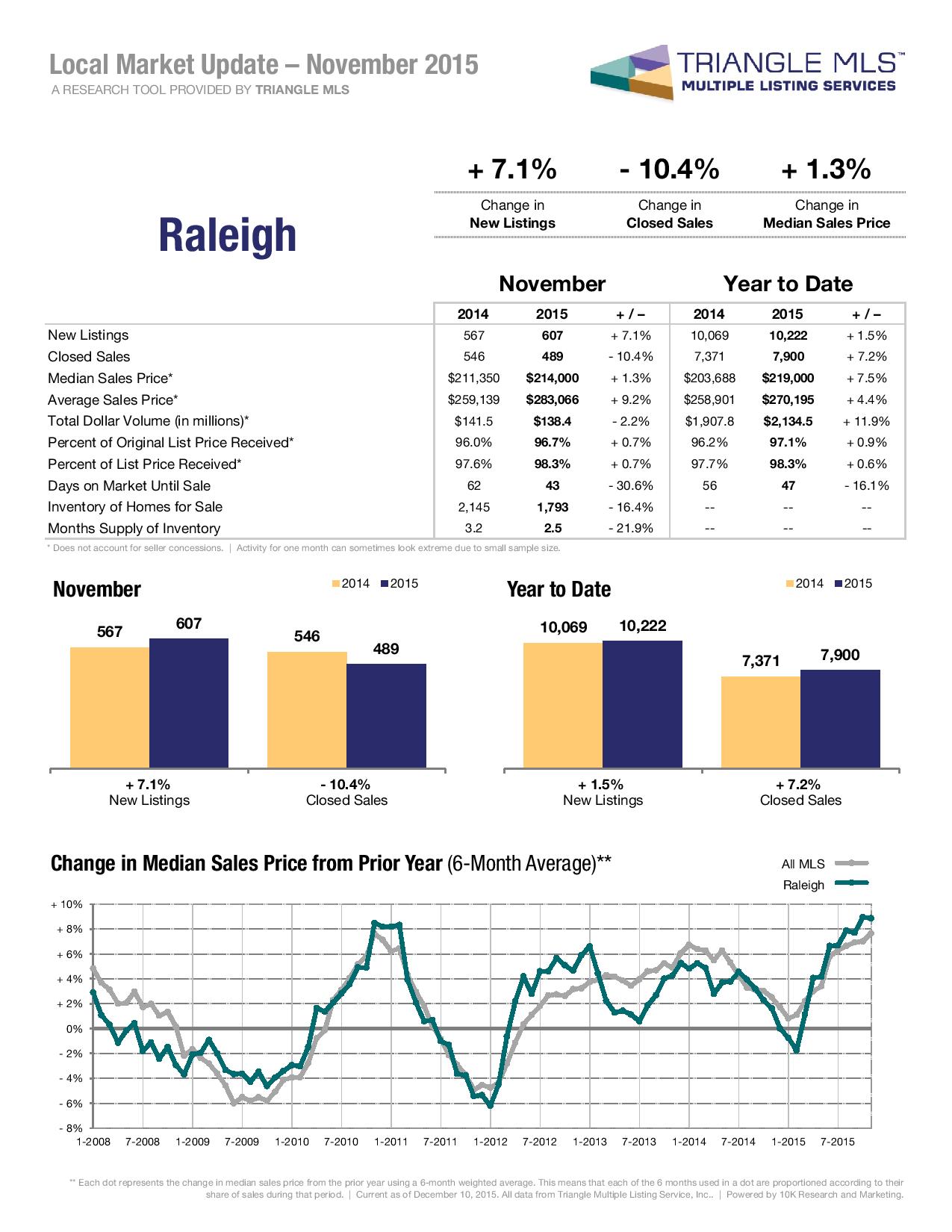
Raleigh Real Estate Market Update November 2015
Posted in
Raleigh Real Estate Market Updates
no comments yet
Nov. 22, 2015
Durham Real Estate Market Summary October 2015
According to the Multiple Listing Service data for the Durham market, in October 2015 nearly all metrics for the real estate market showed a positive increase versus October 2014. The market continues to be strong with 8.5% growth in New Listings, a 3.7% increase in Median Sales Price to $188,750 and a 5.4% increase in Average Sales Price to $218,129.
The market also seems to be holding steady and is not experiencing wide price swings with the Percent of Original List Price Received only increasing 1.3% to 96.4%. So apparently sellers are pricing their homes realistically and close to what the market will bear.
Posted in
Durham Real Estate Market Updates
Oct. 5, 2015
What to Know Before Choosing a Custom Builder
The purchase of a custom-built home can be an exciting and enjoyable experience. Often this type of home is a once-in-a-lifetime dream home that the buyer has anticipated and worked to achieve for many years. From the choice of that perfect floor plan to decisions about appliances, countertops and other details – it all can be a labor of love.
But that much anticipated labor of love could come with unexpected problems like shoddy construction, building delays or even the sudden halting of construction because the builder has run out of money.
Here are a few tips to use when choosing a custom builder that will help avoid these problems.
· Ask how long the builder has been in business. It can take up to three to five years to establish a financially sound business. You not only want the builder to be around to complete your home but also for years afterward to service warranties and provide other support as you use your home. Make sure your builder has that commitment.
· A good custom homebuilder will be an active member of industry associations such as the North Carolina Home Builders Association and the National Association of Home Builders. These groups often hold their members to a higher standard therefore they tend to be more experienced, qualified and dependable. They keep members updated on the most recent building industry requirements and offer continuing education programs and certifications.
o One program is the Accredited Builder program. Graduates have learned about key areas in home construction such as design, building technology, project management, business management, customer service, sales and marketing, computer technology, and leadership. Look for the initials “AB” after the builder’s name.
· Don’t even consider a builder that doesn’t have the required insurance coverage and licenses. Insurance should include workers comp as well as liability insurance coverage so you are covered if someone gets hurt while working on your property.
· Reputable builders will have a process in place for finding and evaluating subcontractors to make sure the quality of their work meets the builder’s standards. Builders who have been in business for years may have developed relationships with trusted contractors over time and they are more likely to be committed to customer satisfaction.
· Choose a builder that has plenty of experience building the type of home you want. For example, if it’s important to you to have an energy efficient home, find a builder who has built several.
· There are various organizations that certify green homes or energy efficient homes. This is a growing trend in the industry and builders should have committed to in-depth study of energy efficient, high performance housing. Look for that certification from your builder.
o One such certification is CGP or Certified Green Professional. Based on the National Green Building Standard, the course includes information on site design; resource, energy and water efficiency; and indoor air quality.
· Get references from the builder, preferably customers who have built a home similar to yours. Ask them about the pros and cons of working with the builder and if they would use him again. Get the names of recent clients from the builder as well as those from several years ago. Check to see if problems have come up as the home has aged. Also contact any subcontractors to see if the builder pays his bills on time.
· Find clients who live in the same development you’re interested in. If the development is run by a homeowner’s association (HOA), talk to the members of the association and the board. If nothing has been built yet, try to speak with owners in a recently finished development by the same builder.
· Check with county planning or building employees that deal with builders.
· Talk with real estate agents who are experienced in the area where you will be building. They may have sold homes built by the builder and may know their reputation.
· Call the state or local licensing or consumer protection agency that oversees builders and contractors. See if there are any complaints have been made against the builder.
· Look up ratings and reviews on the Internet. There are two consumer organizations - Home Owners Against Deficit Dwellings (www.hadd.com) and Homeowners for Better Building (www.hobb.com) - that follow the building industry and act as consumer watchdogs.
· Check with the Better Business Bureau to see if there are any complaints against the builder.
· See if the builder will show you his work himself, both completed and in progress. Or go see it on your own or even with a building inspector. Check for quality of work and materials. A building inspector may also be familiar with the builder and at least tell you if they pull the proper permits.
· Communication is the #1 reason for delays in construction. Make sure you feel you can easily and clearly communicate with the builder. You will be in very close contact during possibly stressful situations so make sure you have confidence you are both able to communicate with each other well.
· Have a complete and clearly written contract. Review it with a real estate attorney and with other real estate professionals to compare to the standard contract for your state. Discuss the differences. Make sure your contract provides a detailed list of what you get for the price you are paying.
· Get a copy of the new home warranty and homeowners manual and read it thoroughly. If the builder has a guarantee, discuss what it includes and get it in writing.
As you can see, there is a great deal to consider when choosing a custom homebuilder and it can be a little overwhelming. The key is to do your research. Take the time that’s necessary to answer the questions on this list. The end result will be a better relationship with your builder, an easier construction process and a very satisfying final product – the home of your dreams.
Posted in
Tips on Buying a Home
Sept. 13, 2015
Creative Decorating for Your Modernist Home
You finally have the home of your dreams – a unique, modernist masterpiece that’s all yours! How do you build on the impression that guests first get from the outside and pull it into the inside of your new home? Here are a few tips to help you make the most of the design of your amazing home.
Sleek, clean lines – Less is more. Keep your design elements relatively unfussy. Keep things simple and uncluttered. Don’t crowd pieces together when placing them in the room.

Photo source: coloradohomeexplorer.com
Open spaces – Modernist design incorporates lots of light so keep that in mind when you choose decorating elements. Use colors and fabrics that blend together and work with the room layout to create an open feel.

Photo source: himedit.com
Neutral colors – Choose a streamlined palate of colors that blend together to form a background for the other elements of the home. Add a splash of color for character.

Photo source: readingandwritingpoetry.blogspot.com
Geometric shapes - Modernist homes love everything that is linear so use geometric elements inside your home too.

Photo source: designermag.org
As with any design philosophy, rules are made to be broken. So be sure to throw in some rule breakers to personalize your interior design. Fill a room with furniture with clean lines and add a piece that has curves and waves. Choose a neutral color palate and then paint one wall a bold contrasting color. Personalization is the best design element of them all so have fun making design choices to express who you are!
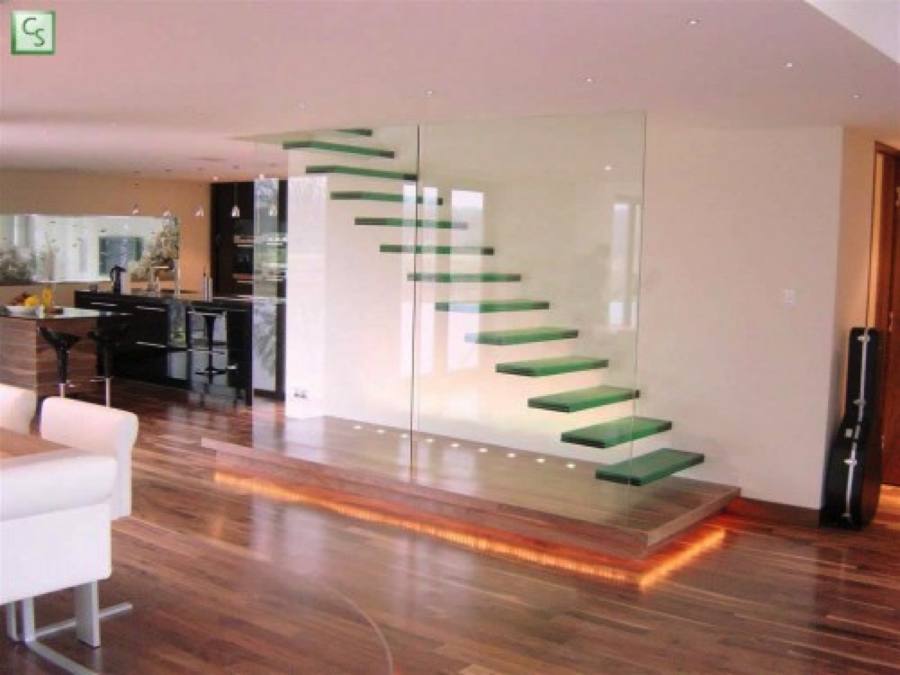
Photo source: housedecoratingideas4you.com
Posted in
Guest Blogger Articles
Aug. 31, 2015
Home Owner Associations - Friend or Foe?
Many homes are part of a community that’s governed by a homeowners association, or HOA. It’s responsible for enforcing the community’s rules and regulations, which are spelled out in the restrictive covenants. Each homeowner becomes a member of the HOA when once they buy property in the community.
HOAs have several benefits. They define changes that can be made to homes and set standards for the community for things such as outside decorations, permitted noise level and fences. In theory, maintaining uniformity or at least limiting choices helps keep values higher. Also, HOAs charge dues and use them to provide amenities such as pools, tennis courts and professional maintenance of the common areas that homeowners might not be able to afford on their own. Many community residents are not even aware of their HOA and just pay their dues and enjoy the benefits.
However, some find that being governed by a HOA has disadvantages. HOA rules can sometimes be excessively restrictive. Also, the HOA also has the legal right to collect assessments beyond the regular dues for large repairs or improvements. These assessments can often be quite high. They can even levy a lien against a homeowner who has made a serious breach of the rules or not paid their dues or assessments. A lien complicates and can even prevent the sale of a home.
There is no independent oversight organization for homeowner associations and laws covering HOAs vary widely from state-to-state. North Carolina has a law titled The North Carolina Planned Community Act that requires the association hold a due process hearing before any property owner can be fined for a rules violation. And it also puts a cap on the amount of the fine.
A HOA can be a friend and a foe, depending on the homeowner and the community. Be sure to carefully research the HOA and the restrictive covenants for the community you are interested in before you buy.
Posted in
Tips on Buying a Home
July 29, 2015
Investing in Triangle Real Estate - Raleigh, Durham, Chapel Hill and the Surrounding Areas
Investing in real estate can be very profitable. Savvy investors have used real estate for years to build their financial portfolios with impressive results.
One of the main benefits associated with real estate investing is the appreciation in the value of the property. The Triangle area has been growing rapidly, and overall North Carolina property values have increased roughly 4% per year over the past 30 years. Like many investments, holding a real estate investment for a long time is the best approach for success.
Another benefit in investing in Triangle real estate is that there has been a strong demand in the rental market. The Triangle area is being featured in the news as one of the best places to live in the country, and Raleigh rents have appreciated an impressive 7.63% in the past year (source: All Property Management). The National Association of Realtors estimates that rents in Raleigh and Cary have increased 16% over the past five years. Rising rents coupled with low vacancy rates means the market is ripe for educated investors to invest wisely in rental properties and experience increased cash flow as rents increase.
As valued real estate advisors for many successful investors, we would welcome the chance to use our education and experience to help you find the right investment to meet your financial goals. For further questions please contact us through the website, or through TriangleHouseHunter@gmail.com.
Posted in
Tips on Buying a Home
July 9, 2015
Triangle Real Estate Market Update Summer 2015
- Showings are booming - up 10% versus year ago (May 2015 versus May 2014).
- Inventory levels are down 17% with new homes declining 3% and resale homes down 20%. There have now been nine months of consecutive decrease in inventory levels compared to the prior year.
- There were 2% more houses listed in May this year than last.
- Supply is very low, which will increase prices.
- Over 1/3 (35%) of current inventory has dropped their price. Overpricing is becoming more common, with negative consequences to the home seller as days on market increases for their listing.
- Half the market is very hot and the other isn’t. A lot depends on how properties are being priced. Upper price points (over $500,000) still lag in many areas.
- Pending sales – up 14% (May 2015 versus May 2014) which is very positive.
- The current average number of days on market is 51, so it is still decreasing. Currently a home is about as liquid an asset as you’ve ever had.
- Average price is 4% up overall versus year ago, 6% for resale homes. We are about 30 to 60 days behind what’s in the market right now so in the Fall it may be as high as 10% if inventory continues to decrease.
Posted in
Market Conditions in the Triangle
May 16, 2015
Durham Real Estate Market Summary First Quarter, 2015
The Durham residential real estate market is very active. With fewer listings and more buyers coming into the market, multiple offers are becoming more common. It’s critical for buyers to be prepared to see new listings quickly and make competitive offers decisively.
Buyer interest in the Durham residential housing market was strong in the first quarter of 2015, with showings experiencing a 16% jump versus the first quarter of the year before. The total number of showings this quarter exceeded those for Q1 for the past four years and virtually equaled the number of showings in Q1 2010. The price range of $100,000 to $200,000 was particularly popular, with the Woodcroft community as one of the top draws.
While buyer interest was increasing, seller participation in the market was decreasing with a 22% reduction in active listings and a 12% decrease in new listings at quarter end versus one year ago. New homes drove that decrease with a reduction in inventory of 34%. Not surprisingly, the average list price of listings showed a 17% increase compared to last year, up to $283, 200. And the average number of days an active listing stayed on the market was down to 104, five days less than the same time last year.
Closings increased 9%, driven by resale homes with an increase in closings of 15%. New home closings decreased 15%, most likely due to the lack of inventory detailed above. The average number of days a closed home was on the market decreased from 78 in Q1 2014 to 63 in this quarter.
A key point to note, however, is that pricing remained stable versus a year ago. Even though the listing prices showed an increase, the average closed price only increased 1% to $208,000. However, that is the highest average sales price since 2007. The median sales price per square foot of detached housing sold during Q1 2015 only increased 2% to $100. Also, financial concessions increased to 68% of closings, up from 51% in the same time last year.
The impact that correct pricing has on the sale of a home at initial list is critical. The initial listing price had a direct relationship to the number of days a home remained on the market. When the closing price equaled the original price, the home was on the market an average of 37 days and sold for 98% of the list price. During this quarter, homes that met this criteria made up 71% of the closings. However, when the final list price was lower than the original list, the home was on the market an average of 127 days and ultimately sold for 90% of the original list price.
Posted in
Durham Real Estate Market Updates
Oct. 22, 2014
Year-round Versus Traditional Schools in the Triangle
Here at Triangle House Hunters we completely understand the importance of your child’s education. Many people are moving here to take advantage of the area’s schools. In fact, a lot of future homeowners narrow their search options so that our listing alerts only send properties that feed into their school of choice. So in addition to having all the up to date school ratings, we also decided to go a step further to find out what other options your family has here in the Triangle. If you are relocating here or just changing school districts, you may have the option of sending your children to a year round school. It seems to be an ongoing debate as to whether or not a year-round schedule is better than the traditional calendar schedule most of us are use to. We don’t like to pick sides here at Triangle House Hunters, rather we’d give you some key facts and pros and cons so you and your kids can decide whether you’ll be vacationing year round or driving cross country all summer long.
The Year-Round Schedule begins in mid-July and utilizes a 45/15 schedule. This means for 45 days students are in session, followed by 15 days (three weeks) of vacation. Regular Holidays are still permitted such as Labor Day, Thanksgiving and Christmas. The year-round schedule has four different tracks. This allows for students to be in session at all times throughout the year. Schools who operate on the year-round schedule operate on a Multi-Track System, which utilizes all 4 tracks, or a Track Four schedule. The Track Four schedule is only the 4th track of the Multi-Track system).
There are several benefits of year-round schooling such as:
1. It allows for smaller class sizes while accommodating the growing population of the Triangle.
2. The continuous instructional schedule is favorable for children with learning disabilities.
3. Having frequent breaks throughout the year can be less stressful for students.
There are also problems that can arise with year-round schooling, such as:
1. May cause scheduling conflicts for families with multiple children.
2. Parents may need to rearrange their traditional work schedules to accommodate the different track systems.
3. Can be difficult to plan family vacations if children are “tracked out” at different times. With the multi-track system, the breaks for different children may occur at different times.
Posted in
Tips on Buying a Home